

Most of the "skills" of the future aren't skills — and what they actually are determines how you grow them
For about a century, getting better at your job meant acquiring skills: things that could be taught, tested, and hired for. That whole apparatus rested on a quiet assumption: that human value is made of capabilities you can specify. AI is dissolving that assumption, because anything you can fully specify, you can automate. The measurable is becoming the machine's.
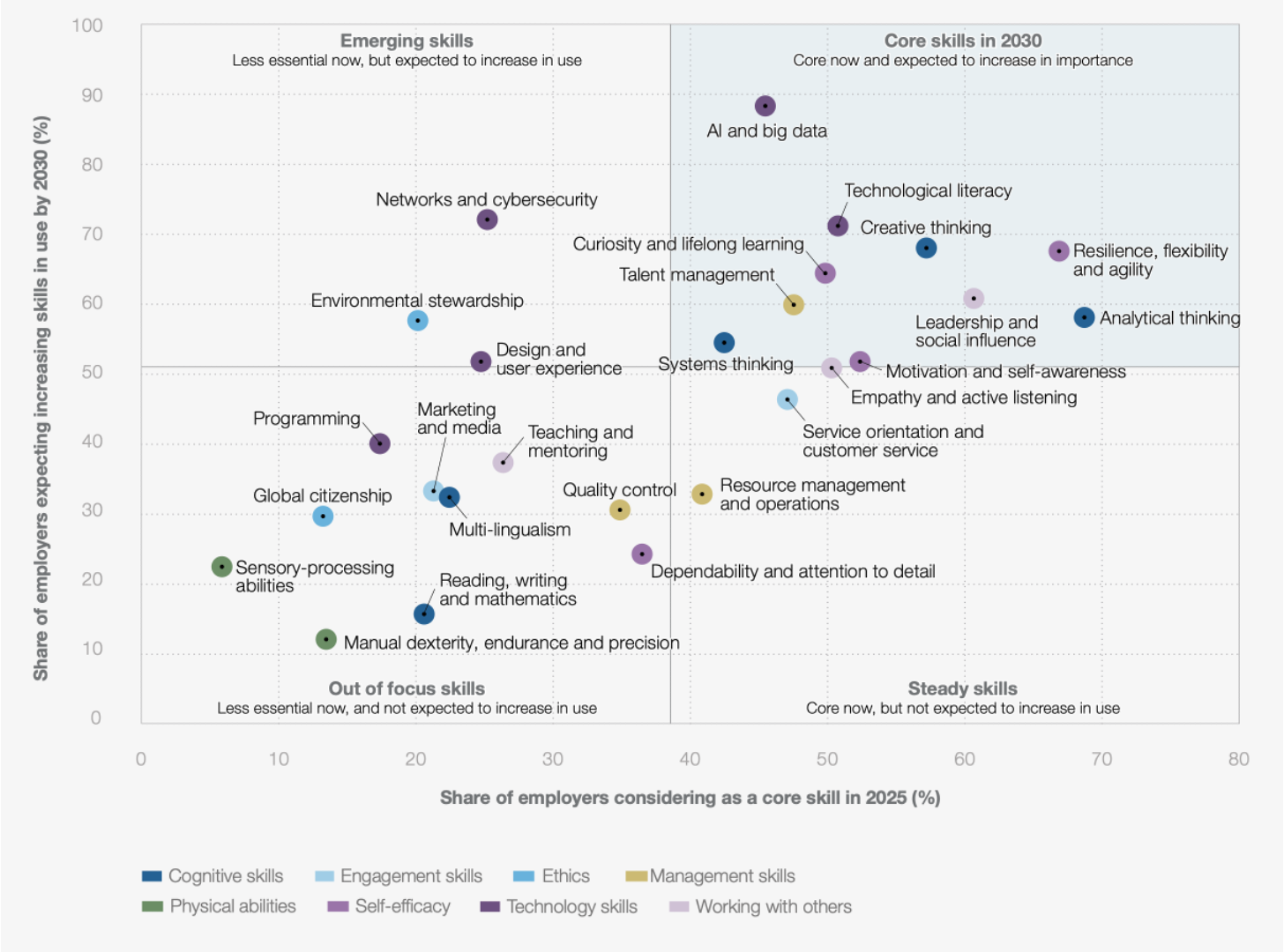
As that tide goes out, what's left exposed is a strange, short list. Judgment. Adaptability. Empathy. Curiosity. Resilience. Knowing what's worth doing. The forecasts converge on it: across the six major future-of-work reports in our meta-synthesis (more than fifty distinct "skills" among them), the same short list keeps surfacing at the top. The most visible case is the World Economic Forum's (WEF) Future of Jobs research, which surveys employers and plots what they consider core skills against what they expect to grow in importance. The result is a quadrant map: bottom left, the out-of-focus skills, less essential now and not expected to increase; top right, the core skills of 2030, core now and still rising. Look at what actually sits in that top-right quadrant, and a simple question follows: are these really skills?
Skills, Competencies, Capacities
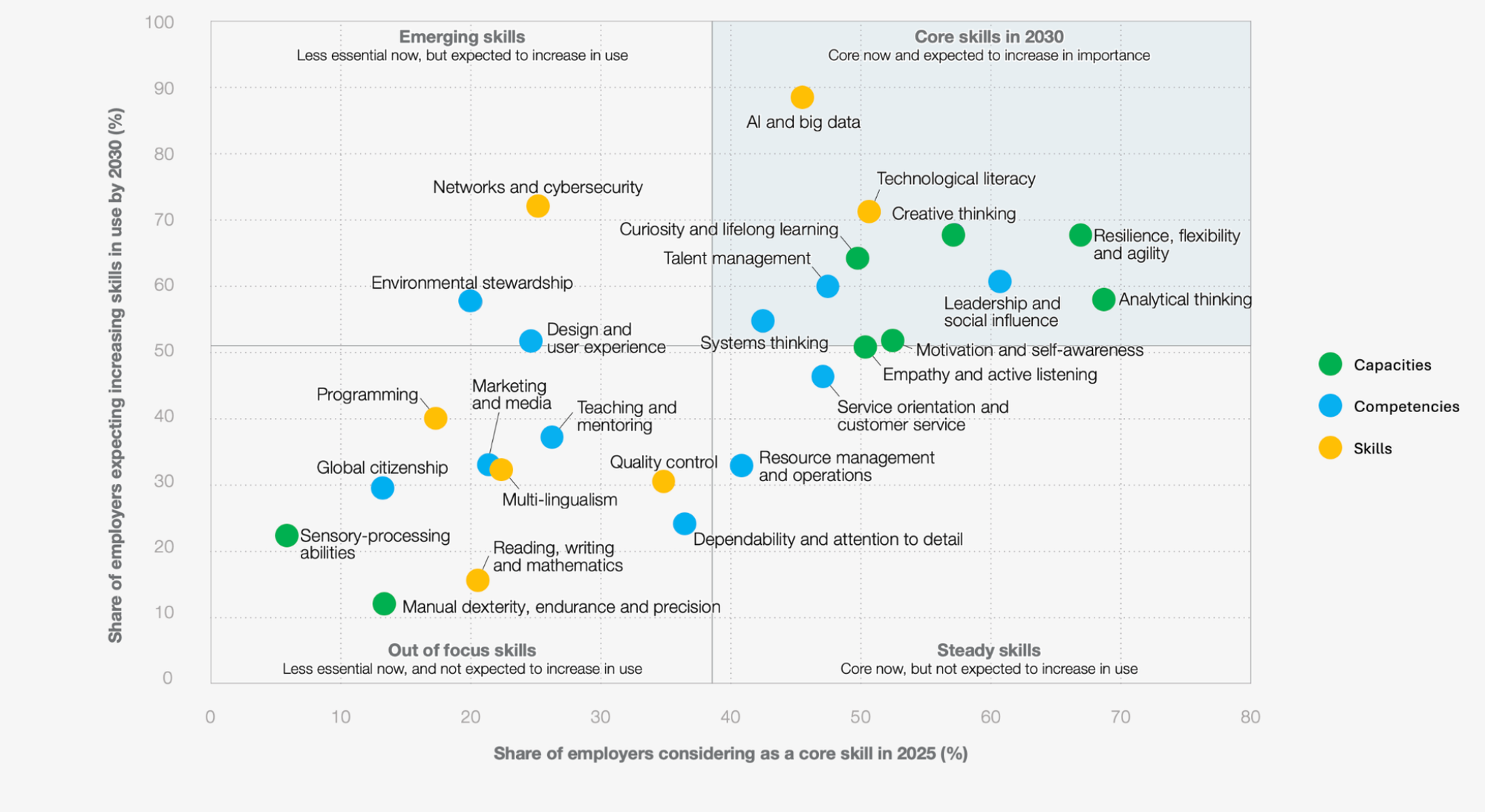
The answer is no, at least not in the broad way WEF uses the word. There is another way of mapping these items, and for anyone asking what will make an organization and its leaders competitive in the decade ahead, it is the more valuable one. We distinguish between skills, competencies, and capacities.
A skill can be installed: taught and transferred in a repeatable, testable way so that someone can perform a specific task (reading, writing, mathematics). A competency is developed: the demonstrated combination of knowledge, skills, judgment, and experience needed to perform in a role (design and user experience, cybersecurity, leadership and social influence), built over time, usually by working alongside someone more experienced through work of increasing complexity.
A capacity is different in kind. It is a person's readiness and potential to grow, adapt, and take on more complex and demanding responsibilities over time. You cannot install empathy or curiosity into a person, and you cannot develop them directly the way you develop a competency. A capacity can only be cultivated, and cultivation is indirect: you work on what surrounds it (the conditions, the relationships, the challenges a person is given) so that it can grow in its own time. Which is why it cannot be rushed or standardized. The same program will grow a capacity differently in different people, and on its own timeline rather than the organization's. Capacities are what our other work calls emergent outcomes, and the same principle governs both names: whatever reaches one reaches it indirectly.
Sort the WEF chart into those three bins, as our analysis did, and the finding is hard to unsee: most of the things WEF calls skills (the things much of the marketplace calls skills) aren't skills at all. The majority of the core "skills" of 2030 are capacities, the rest competencies; only two are skills in the strict sense.
Take resilience. WEF files it under skills. Developmental psychologists define it – unsurprisingly – with a more nuanced take. That is, resilience represents a dynamic process of positive adaptation in the face of significant adversity (see Luthar, Cicchetti, & Becker, 2000). You cannot take a course in it and suddenly achieve a grade of resilient at the end. You cannot install it because it is not something humans are naturally lacking. It unfolds through how a person meets what is difficult, and it looks different in every person and every context. The same is true of curiosity, of empathy, of the judgment to know what's worth doing in ambiguous conditions. These are not skills. They are closer to character — to who a person has become. The economy has started demanding character and filing it under "skills gap."
The Wrong Name, The Wrong Program
The misnaming would be a quibble if it were only vocabulary. It is not, because names determine architecture. Organizations that need these qualities in their leaders cannot approach them as skills, because they aren't skills, and cannot approach them as competencies, because they aren't competencies. They have to be approached as capacities, which means the programs aimed at them must satisfy the architectural and experiential conditions cultivation requires, conditions skills-based and competency-based programs are not built to meet. Yet we keep applying skills-based methods to capacity-based needs, and the mismatch is fundamental. The harder we push, the wider the gap gets. Meanwhile, AI erodes the very capacities it was supposed to make room for: a capacity you stop exercising fades. We are spending more and more to teach the one thing that can't be taught.
The Know-How Was in the Wrong Building
The knowledge of how to grow this part of a person was never missing. It was in a different building. For a hundred years, the therapeutic and developmental traditions have been doing exactly this work: growing the capacity to watch your own mind, to stay with what's hard, to put words to what you only feel, to author your own sense of worth instead of borrowing it. Take sixteen of those traditions, each a family of evidence-based interventions. Trace them from their mechanisms of change to the capacities those mechanisms presuppose and cultivate, as our mapping did, and the same handful shows up every time. The thing the economy now needs turns out to be the thing the change traditions have always cultivated. Repairing what's broken was never the whole of it; they were growing a human interior. The market just walked up to the same door from the opposite side.
And you grow that interior the way it has always been grown: by working the hidden model a person runs on, the assumptions about what they're worth, who they have to be. You bring that model into view until the person can hold it instead of being held by it. That is cultivation, not training. It is slow and personal and looks nothing like a curriculum, which is why programs that try to install capacities like skills will keep failing, no matter how well designed. The architecture is wrong for the material. You cannot install something that already lives within a person. You can only create the conditions for it to emerge, and then cultivate it, so that the person grows able to take on increasingly complex, ambiguous, and challenging work, and to do it successfully.
Growth Leaves a Signature in Language
The obvious objection is that none of this can be measured. A capacity has no test the way a skill does: no exam for curiosity, no certification in resilience. And an unmeasurable promise is hard to distinguish from an empty one, which is partly why the market has priced the interior at zero. The objection deserves an answer, and it has one: growth of this kind can be seen in language.
The hidden model a person runs on does not stay hidden. It speaks. Every account a person gives of what happened and why is the model rendered in words, and the person rarely knows they are rendering it. That is what makes language the honest instrument: it is produced constantly, it is hard to fake for long, and it is generated by the same model cultivation works on. Change the model and the words change, because the words were never separate from it.
The change shows in recognizable ways. "They made me" becomes "I chose." "I'm terrible at this" becomes "that didn't go the way I hoped." "What will they think" becomes "what do I think," the borrowed yardstick giving way to an internal one. The growth that has no test leaves a signature, and the signature is written in how someone talks. Reading that signature systematically is where our measurement work is aimed.
Workforce Development as Human Development
The machine that can do everything external is making the internal economically essential for the first time at scale, and the means to grow it (and to see it growing) have existed all along, in the wrong building, under the wrong name. What remains is to carry them across: to treat workforce development as human development, name the capacities for what they are, cultivate them by changing the model underneath, read the change in language, and stop pretending any of this can be installed. The market's blind spot — the part of a person it can't name, can't train, can't measure, can't buy — is the entire point.
References
Luthar, S. S., Cicchetti, D., & Becker, B. (2000). The construct of resilience: a critical evaluation and guidelines for future work. Child development, 71(3), 543–562. https://doi.org/10.1111/1467-8624.00164
World Economic Forum. (2025). The future of jobs report 2025. World Economic Forum.